


Ever wonder why big tech firms in Cyberport or Silicon Valley leave old tables? In our fast-paced world, modern apps need great speed. Understanding nosql database is what helps developers build *better* apps.
These tools handle big files with ease. Traditional rows often fail under heavy pressure. Flexibility matters most today.
Non-tabular systems help teams grow. We explore how these non-relational systems work for you. Digital growth across Hong Kong requires scalable solutions.
Old software designs struggle when users grow rapidly. Innovative architectures allow teams to store documents without fixed patterns. Learning about distributed storage unlocks new potential for startups.
Such platforms manage social media feeds or shopping carts seamlessly. They offer high availability during peak traffic hours. Embracing flexible schemas ensures your project *truly* stays ahead.
Registry performance keeps users happy. Engineers choose specific frameworks to manage vast networks. These non-tabular choices provide agility in competitive markets.
Hong Kong developers value reliability. Integrating distinct storage methods provides distinct edges. Explore this journey to master contemporary storage methods.
Key Takeaways
- Flexible storage structures improve efficiency.
- Non-relational tools scale horizontally.
- High performance suits real-time applications.
- Modern tech supports diverse content types.
- Distributed systems ensure constant uptime.
- Scalable designs manage big data sets.
Understanding What Is a NoSQL Database
The rise of NoSQL databases marks a significant departure from the conventional relational database management systems. This shift is driven by the need to handle diverse and complex data structures that traditional databases struggle to manage efficiently.
The Shift from Relational Models
Traditional relational databases have been the cornerstone of data storage for decades, relying on a fixed schema and structured query language (SQL) to manage data. However, the limitations of this model became apparent with the advent of big data and the need for greater flexibility in data modeling.
NoSQL databases emerged as a response to these limitations, offering a more flexible data model that can handle large volumes of unstructured or semi-structured data. This flexibility is crucial for applications that require rapid iteration and adaptation to changing data structures.
Defining Non-Relational Architecture
NoSQL databases are characterized by their non-relational architecture, which allows for a variety of data models such as document, key-value, wide-column, and graph stores. This diversity enables developers to choose the most appropriate data model for their specific use case.
| NoSQL Database Type | Description | Example Use Cases |
|---|---|---|
| Document Store | Stores data in self-describing documents | Content management, real-time analytics |
| Key-Value Store | Stores data as a collection of key-value pairs | Session management, caching |
| Wide-Column Store | Stores data in columns instead of rows | Big data analytics, data warehousing |
| Graph Database | Stores data as nodes and edges | Social networks, recommendation engines |
The non-relational architecture of NoSQL databases provides the scalability and performance needed for modern applications, making them an attractive choice for businesses dealing with large amounts of diverse data.
The Evolution of Data Storage in the Digital Age
In today’s data-driven world, the need for efficient and scalable data storage solutions has never been more pressing. The exponential growth of digital data, coupled with the increasing complexity of modern applications, has rendered traditional database solutions inadequate.
The limitations of conventional databases have become apparent as they struggle to keep pace with the demands of modern data storage and analytics. Traditional SQL databases, with their rigid schema and vertical scaling limitations, face significant challenges in handling the vast amounts of unstructured and semi-structured data generated by contemporary applications.
Why Traditional SQL Faced Challenges
Traditional SQL databases were designed for a different era, one where data was more structured and the scale was significantly smaller. The rigid schema of SQL databases makes it difficult to adapt to changing data models or to handle the variety of data types that modern applications generate.
Moreover, the vertical scaling approach of SQL databases, which involves increasing the power of a single server, has its limits. As data volumes grow, this approach becomes not only expensive but also technically challenging.
The Rise of Big Data and Real-Time Analytics
The advent of big data and the need for real-time analytics have further highlighted the shortcomings of traditional SQL databases. Big data, characterized by its volume, velocity, and variety, requires databases that can handle high throughput and provide low-latency responses.
NoSQL databases have emerged as a solution to these challenges, offering flexible schema designs, horizontal scalability, and the ability to handle a wide range of data types. By distributing data across multiple servers, NoSQL databases can scale more efficiently and cost-effectively than traditional SQL databases.
The differences between NoSQL and SQL databases are significant, and understanding these differences is crucial for selecting the right database solution for specific use cases. While SQL databases excel in environments where data consistency and transactional support are paramount, NoSQL databases are better suited for applications that require flexibility, scalability, and high performance.
Core Characteristics of NoSQL Databases
At the heart of NoSQL databases lies a set of characteristics that enable flexible and scalable data management. These databases are designed to address the limitations of traditional relational databases, offering a more adaptable approach to data storage and retrieval.
Schema Flexibility and Dynamic Data Models
NoSQL databases are renowned for their schema flexibility, allowing developers to store data without a predefined schema. This flexibility is particularly beneficial in agile development environments where data structures are likely to evolve over time.
Dynamic data models enable the easy adaptation to changing data structures, making NoSQL databases ideal for applications with rapidly evolving data requirements. For instance, document-oriented NoSQL databases like MongoDB allow for the storage of data in flexible, JSON-like documents.
Horizontal Scalability Explained
Another key characteristic of NoSQL databases is their ability to scale horizontally. This means that as the dataset grows, the database can handle the increased load by simply adding more servers to the cluster. Horizontal scalability is crucial for applications that experience rapid growth or have unpredictable traffic patterns.
NoSQL databases achieve horizontal scalability through various methods, including sharding and replication. This scalability is a significant advantage in big data and real-time web applications, where the ability to handle large volumes of data across multiple servers is essential.
Understanding these core characteristics is vital for appreciating the value that NoSQL databases bring to modern data-driven applications. By leveraging schema flexibility and horizontal scalability, developers can build more robust, scalable, and adaptable data management systems.
Key Types of NoSQL Databases
The NoSQL ecosystem is characterized by a variety of database types, each with its strengths. This diversity allows developers to choose the most suitable database based on the specific requirements of their applications.
Document Stores and Key-Value Pairs
Document stores are one of the most popular types of NoSQL databases. They store data in self-describing documents, such as JSON or XML, making it easy to store and retrieve complex data structures. Examples include MongoDB and Couchbase. Document stores are ideal for content management systems and real-time analytics due to their flexibility and scalability.
Key-value pairs, on the other hand, are simple databases that store data as a collection of key-value pairs. They are highly performant for certain use cases, such as caching and session management. Examples include Redis and Riak. Key-value stores are known for their high performance and simplicity.
Wide-Column Stores and Graph Databases
Wide-column stores are designed to handle large amounts of data across many servers. They store data in columns instead of rows, which makes them efficient for analytical queries. Examples include Cassandra and HBase. Wide-column stores are suitable for big data analytics and IoT applications due to their ability to handle high write throughput.
Graph databases are specialized databases designed to store and query complex relationships between data entities. They use graph theory to store data, making them ideal for applications that require complex relationship mapping, such as social networks and recommendation engines. Examples include Neo4j and Amazon Neptune. For more information on the different types of NoSQL databases, you can visit GeeksforGeeks.
NoSQL databases offer a range of options for handling different types of data and use cases, making them a versatile choice for modern applications.
Comparing NoSQL and SQL Databases
In the realm of database management, the debate between NoSQL and SQL databases centers around their structural differences, performance trade-offs, and consistency models. As businesses and developers navigate the complex landscape of data storage and management, understanding these differences is crucial for making informed decisions.
Structural Differences in Data Handling
NoSQL databases are designed to handle a variety of data formats, including key-value, document, graph, and column-family stores. This flexibility allows developers to adapt their data models as needed, without being constrained by a predefined schema.
In contrast, SQL databases rely on a fixed schema that defines the structure of the data before it is stored. While this can make data management more predictable and enforce data consistency, it can also limit flexibility when dealing with evolving or complex data sets.
A key structural difference lies in how data is normalized and related. SQL databases use normalization to minimize data redundancy and dependency, whereas NoSQL databases often sacrifice normalization for higher performance and scalability, using techniques like denormalization.
Performance Trade-offs and Consistency Models
Performance is a critical factor when choosing between NoSQL and SQL databases. NoSQL databases are often optimized for high availability and scalability, making them suitable for large-scale, distributed systems. However, this can come at the cost of consistency, as many NoSQL databases adopt eventual consistency models to achieve higher availability.
“The CAP theorem states that it is impossible for a distributed data store to simultaneously guarantee more than two out of the following three characteristics: consistency, availability, and partition tolerance.”
SQL databases, on the other hand, typically prioritize consistency and adhere to ACID (Atomicity, Consistency, Isolation, Durability) principles, ensuring that database transactions are processed reliably. However, achieving high consistency can sometimes limit scalability and performance.
| Database Type | Consistency Model | Scalability |
|---|---|---|
| NoSQL | Eventual Consistency | High |
| SQL | Strong Consistency (ACID) | Variable |
Ultimately, the choice between NoSQL and SQL databases depends on the specific needs of the application or business. By understanding the structural differences, performance trade-offs, and consistency models of each, developers can make informed decisions that align with their project requirements.
Advantages of Adopting NoSQL Solutions
In today’s data-driven world, NoSQL solutions are increasingly being adopted for their ability to efficiently manage unstructured data and support rapid application development. This shift is largely driven by the need for greater flexibility and scalability in data management.
NoSQL databases offer a number of significant advantages, particularly in handling the complexities of modern data. As Forbes notes, “The flexibility of NoSQL databases allows developers to iterate quickly and make changes to the data model without having to worry about the constraints of a predefined schema.”
Handling Unstructured Data Efficiently
One of the key benefits of NoSQL databases is their ability to handle unstructured or semi-structured data efficiently. Unlike traditional relational databases, which require data to be structured into predefined schemas, NoSQL databases can manage a wide variety of data formats. This makes them particularly useful for applications that involve big data, real-time analytics, and content management.
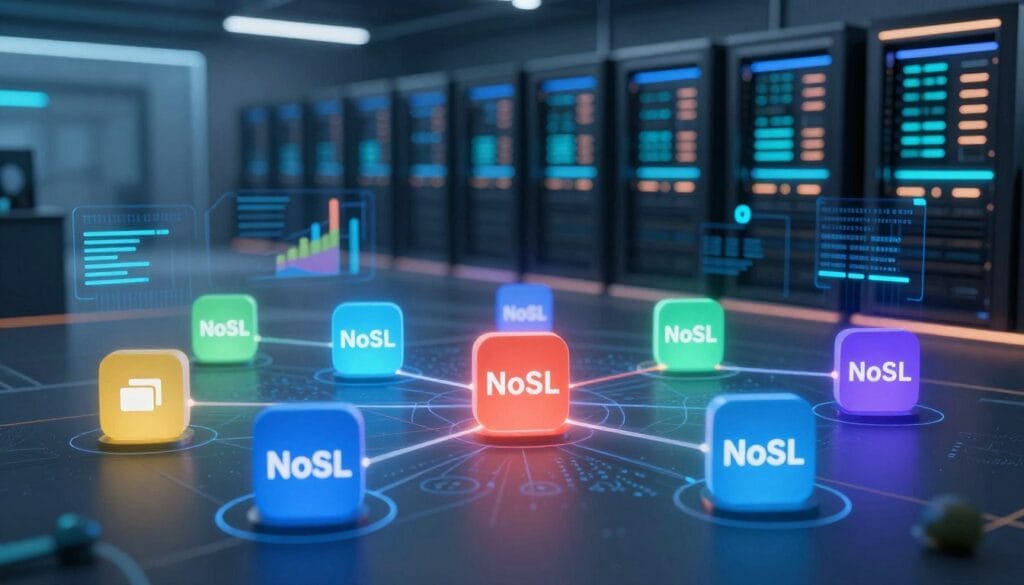
For instance, document-oriented NoSQL databases like MongoDB allow for the storage of data in JSON-like documents, making it easier to work with data that doesn’t fit into a traditional table structure. As MongoDB’s documentation highlights, “Document-oriented databases are designed to store, manage, and retrieve large volumes of document data.”
Rapid Development Cycles for Modern Apps
NoSQL databases also facilitate rapid development cycles, which are crucial for modern applications that require quick iterations and deployments. The flexible schema of NoSQL databases means that developers can make changes to the data model on the fly, without the need for extensive migrations or downtime.
This flexibility is particularly beneficial for startups and businesses in fast-paced industries, where the ability to quickly adapt to changing market conditions can be a significant competitive advantage. As noted by TechCrunch, “The agility provided by NoSQL databases is a game-changer for companies looking to innovate and disrupt traditional markets.”
By adopting NoSQL solutions, businesses can not only improve their data management capabilities but also accelerate their development cycles, leading to faster time-to-market and greater overall efficiency.
Potential Drawbacks and Considerations
While NoSQL databases offer numerous benefits, they also come with their own set of challenges. As organizations consider adopting NoSQL solutions, it’s essential to understand these drawbacks to make informed decisions.
Eventual Consistency Complexity
One of the significant challenges of NoSQL databases is the concept of eventual consistency. Unlike traditional relational databases that adhere to strong consistency models, many NoSQL databases opt for eventual consistency to achieve higher availability and scalability.
This means that data may not be immediately consistent across all nodes in the system. Instead, it will become consistent eventually. While this model works well for certain applications, it can be complex to manage, especially in scenarios where immediate consistency is required.
Learning Curve for Traditional Database Administrators
Traditional database administrators often face a steep learning curve when transitioning to NoSQL databases. The shift from relational databases to NoSQL requires a different mindset and skill set, particularly in understanding the various data models and query languages used by NoSQL databases.
For instance, administrators need to become familiar with the query mechanisms of their chosen NoSQL database, whether it’s MongoDB’s query language or Cassandra Query Language (CQL) for Cassandra.
Comparison of NoSQL Database Challenges
| Challenge | Description | Impact |
|---|---|---|
| Eventual Consistency | Data may not be immediately consistent across all nodes. | Complex to manage, potential data inconsistencies. |
| Learning Curve | Steep learning curve for traditional DBAs. | Requires significant training and adaptation. |
| Lack of Standardization | NoSQL databases lack standardization. | Difficulty in switching between different NoSQL databases. |
In conclusion, while NoSQL databases offer many advantages, they also present several challenges that organizations must consider. Understanding these potential drawbacks is crucial for successful adoption and implementation.
Common Use Cases and Industry Applications
As data complexity grows, NoSQL databases are increasingly being utilized in diverse applications. Their flexibility and scalability make them an ideal choice for various industries, from content management to personalized user experiences.
Real-Time Content Management Systems
NoSQL databases are particularly effective in real-time content management systems. They enable the handling of large volumes of unstructured or semi-structured data, which is common in content-rich applications.
Key Benefits include the ability to manage diverse data types and scale horizontally to accommodate growing content demands. For instance, a popular content management platform might use a NoSQL database to store user-generated content, metadata, and other relevant information.
| Feature | Description | Benefit |
|---|---|---|
| Flexible Schema | Allows for dynamic changes in data structure | Eases the management of evolving content types |
| High Scalability | Supports horizontal scaling | Handles increased traffic and data volume |
| Real-Time Data Handling | Enables immediate data processing | Enhances user experience with up-to-date content |
Personalization Engines and User Profiles
NoSQL databases also play a crucial role in personalization engines and user profile management. They can efficiently store and process complex user data, preferences, and behavior patterns.
Personalization engines leverage this data to offer tailored experiences, improving user engagement and satisfaction. For example, an e-commerce platform might use a NoSQL database to manage user profiles, track browsing history, and recommend products based on user behavior.

The use of NoSQL databases in these applications not only enhances performance but also allows for more sophisticated data analysis, driving business insights and strategic decisions.
Real-World Success Stories and Case Studies
With the rise of big data, NoSQL databases have emerged as a critical component in the tech stack of many global leaders, facilitating real-time data processing and analytics. This shift has enabled companies to innovate and expand their data management capabilities significantly.
The use of NoSQL databases has been particularly impactful for global tech giants, who require scalable and flexible data management solutions to handle their vast and diverse data sets.
Global Tech Giants and NoSQL Utilization
Many global tech giants have successfully integrated NoSQL databases into their infrastructure. For instance, companies like Facebook and Amazon have utilized NoSQL databases to manage their enormous volumes of user data and transactional information efficiently.
Key Examples Include:
- Facebook’s use of Cassandra for inbox search functionality, handling vast amounts of data across thousands of servers.
- Amazon’s DynamoDB, a fully managed NoSQL database service that provides fast and predictable performance with seamless scalability.
Impact on Hong Kong Startups and Fintech
In Hong Kong, the fintech sector has seen significant growth, with NoSQL databases playing a crucial role in this development. Startups and established companies alike have leveraged NoSQL solutions to enhance their data handling capabilities and improve customer experiences.
| Company | NoSQL Database Used | Application |
|---|---|---|
| WeLab | MongoDB | Credit scoring and risk management |
| Octopus Cards Limited | Cassandra | Real-time transaction processing |
| HSBC | Couchbase | Personalization and customer profiling |
The adoption of NoSQL databases has enabled these companies to innovate and stay competitive in a rapidly evolving fintech landscape.
Future Trends in Database Technology
The database landscape is evolving rapidly, driven by technological innovations. As organizations increasingly rely on data-driven decision-making, the demand for more flexible, scalable, and performant databases is on the rise.
This shift is leading to significant advancements in database technology, particularly in the convergence of SQL and NoSQL databases and the development of cloud-native database innovations.
The Convergence of SQL and NoSQL
The distinction between SQL and NoSQL databases is becoming increasingly blurred. SQL databases are incorporating NoSQL features, such as flexible schema designs, while NoSQL databases are adopting SQL-like query capabilities. This convergence is driven by the need for databases that can handle both structured and unstructured data efficiently.
- Improved data modeling capabilities
- Enhanced query flexibility
- Better support for real-time analytics
A key aspect of this convergence is the nosql database comparison with traditional SQL databases, highlighting the differences between nosql and sql databases in terms of data handling and scalability.
Cloud-Native Database Innovations
Cloud-native databases are designed to take full advantage of cloud computing principles, such as scalability, elasticity, and high availability. These databases are optimized for the cloud, offering improved performance, reduced latency, and enhanced reliability.
Some key features of cloud-native databases include:
- Auto-scaling capabilities
- Serverless architecture support
- Integrated security and compliance
As cloud adoption continues to grow, cloud-native databases are poised to become the norm, offering organizations greater agility and flexibility in their data management strategies.
Conclusion
Understanding what is a NoSQL database and how it functions is crucial in today’s data-driven world. A NoSQL database is what allows for flexible schema design, handling large amounts of unstructured or semi-structured data, and scaling horizontally to meet the demands of modern applications.
As discussed, NoSQL databases have evolved to address the limitations of traditional SQL databases, offering various types such as document stores, key-value pairs, wide-column stores, and graph databases. Each type caters to different needs, making NoSQL a versatile solution for real-time content management, personalization engines, and more.
With the rise of big data and real-time analytics, adopting NoSQL solutions can provide significant advantages, including efficient handling of unstructured data and rapid development cycles. While there are potential drawbacks, such as complexity in eventual consistency and learning curves for traditional database administrators, the benefits often outweigh these challenges.
As the database technology landscape continues to evolve, the convergence of SQL and NoSQL, along with cloud-native innovations, will shape the future of data storage and management. Exploring NoSQL databases further can unlock new possibilities for businesses and developers in Hong Kong and beyond.